
9 August 2025
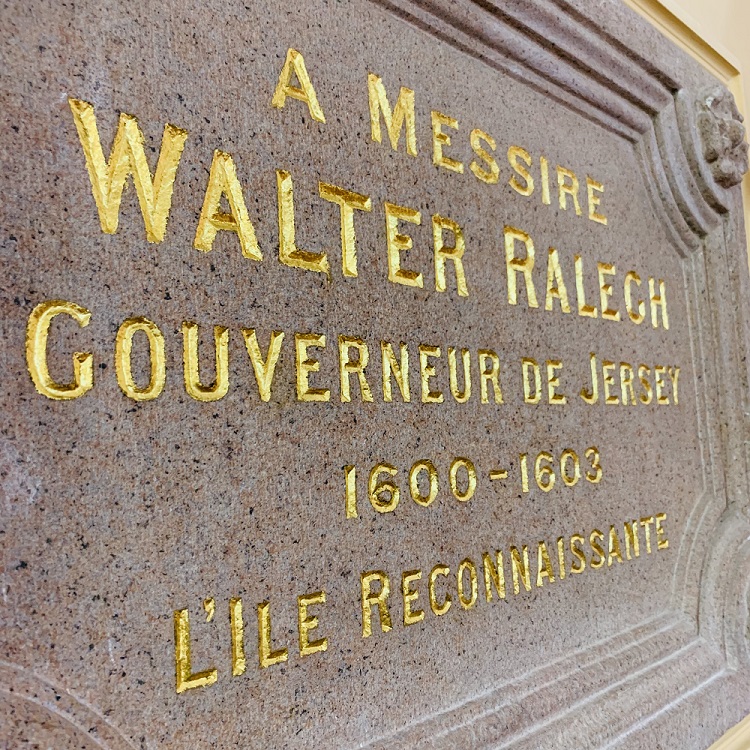
On one of the walls of the public gallery inside the States Chamber you’ll find a sandy-coloured stone with rather a famous name on it, that of Sir Walter Raleigh – or Ralegh as it appears on the slab.
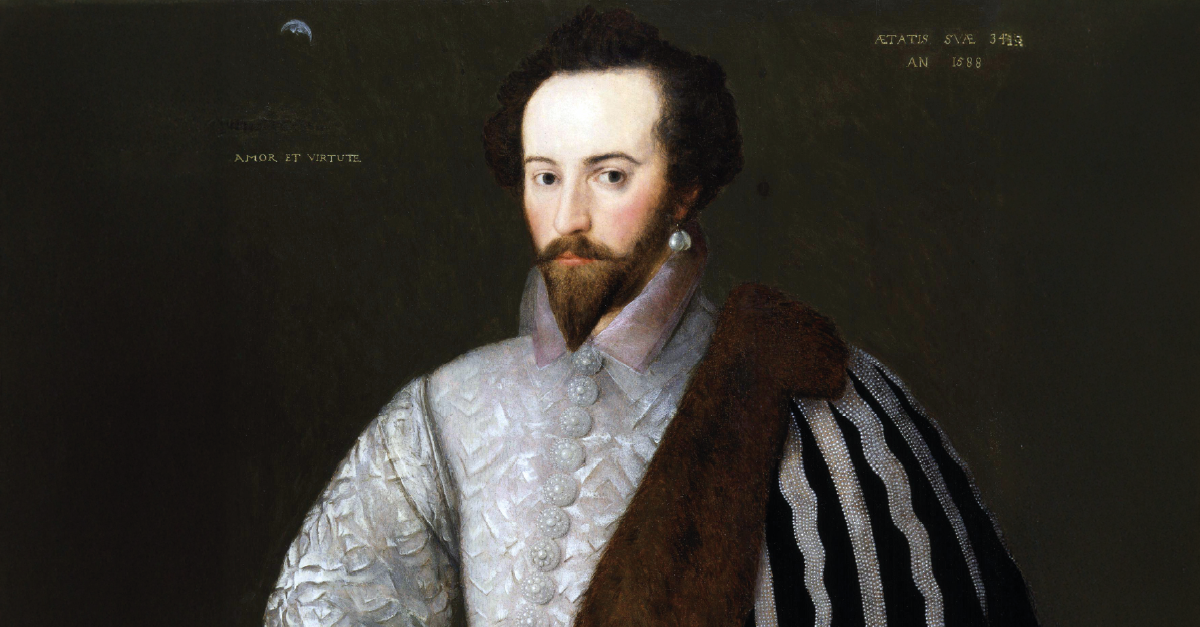
The English explorer is perhaps best known for his links to Queen Elizabeth I and - if the stories are true - for introducing potatoes and tobacco to Great Britain.
So why does his name appear on a stone in the home of Jersey’s elected parliament? To answer that, we should begin by looking at the man himself.
Sir Walter Raleigh
Born in Devon around 1554, Sir Walter Raleigh grew up in a family of Protestants. As this was during the reign of the Catholic Queen Mary I, the family were persecuted although records show a relative did work as a governess for the young Princess, later Queen, Elizabeth.
Not much is known about his early years, but by the time he was a teenager in the 1570s he had begun his career as an explorer. His early voyages, along with his half-brother Sir Humphrey Gilbert, included unsuccessful attempts to find the Northwest Passage (a much-desired sea route through North America to the Pacific Ocean).
In 1580 he helped to supress an uprising in Ireland, an action which brought him to the attention of Queen Elizabeth I. She invited the young explorer to court and took an interest in him, thanks in part to his reported good looks.
In the years that followed, Raleigh was granted permission to establish expeditions to explore North America, which eventually led to the formation of a colony on Roanoke Island. While he didn’t lead those expeditions, in 1596 he did set off in search of El Dorado in South America, his first of two attempts to locate the fabled golden city.
Raleigh vs RaleghRaleigh’s links with Jersey
In 1891, the Victorian biographer William Stebbing addressed the spelling of Sir Walter’s surname in detail. It seems the confusion comes from the man himself who used various spellings during his lifetime, as was common practice during the period. However, Stebbing does note that the spelling which we use today was not one Sir Walter is known to have used himself.
In July 1600, the then Governor of Jersey – Sir Anthony Poulet – died and according to research carried out by the Société Jersiaise, Sir Walter Raleigh lobbied to replace him. He was successful and, on the 20 September 1600, he appeared at a meeting of the States Assembly where the oath of office was administered.
The research suggests that while he didn’t stay in Jersey for the whole of his tenure, as we might expect today, he did visit the Island when possible. He wrote constantly to the States to make sure he was carrying out his duties and returned whenever his presence was required.
An example of this, from July 1602, involved a feud between Jurat Jean de Carteret and the Bailiff George Paulett. De Carteret had suggested that Paulett had ceased to be Bailiff on the death of the previous Governor. Raleigh was asked to decide if that was the case, and he ruled that as long as the Bailiff had been properly elected, they would remain as Bailiff until, for some reason or other, they were deprived of their office.
Sir Walter Raleigh served as Governor until 1603 when he was removed following the death of Queen Elizabeth I. He was arrested for treason after being implicated in a conspiracy to overthrow her successor, King James I. Raleigh was found guilty, but his death sentence was suspended, and he was imprisoned in the Tower of London instead.
Thirteen year later, in 1616, he was released by order of the King to undertake an expedition to Guiana to search for gold. The search was unsuccessful. During the trip however, a Spanish settlement was attacked. It was seen by the King of Spain as an act of inciting war and to keep the peace, King James I reinstated Sir Walter Raleigh’s death sentence. He was executed on 29 October 1618 outside the Palace of Westminster.
His time as Jersey’s Governor
Multiple sources describe Sir Walter as a ‘hands on’ Governor. He is credited with improving Jersey’s Militia and defences, fostering trade and introducing a registry for title deeds.
A soldier himself, Raleigh knew the importance of a well-trained military. He took it upon himself to ensure the Militia were properly drilled and equipped and made sure that Jersey’s fortifications were in a proper state to defend the Island if needed.
Extract from Société Jersiaise Annual Bulletin – 1919 (translated)While some trade in Newfoundland cod already existed in the Island, Raleigh took an active interest in promoting it, further transforming what had been isolated incidents into something much larger and more commercial.
It seems to me that the people of Jersey should feel a genuine satisfaction that the name of a man of this eminence is found inscribed on the Roll of our Governors.
And while there’s some debate about potatoes, what has been agreed is that Raleigh introduced tobacco – or ‘petun’ - to Jersey. It is said that he would smoke his pipe during States sittings, dressed in the height of fashion.
He is also credited as the man who gave Elizabeth Castle - Fort Isabelle Bellissima - its name and as the man who saved Mont Orgueil from destruction.