
.png "Occupation-80-(1).png") Pictures courtesy of Jersey Heritage.
Pictures courtesy of Jersey Heritage.Between 1940 and 1945, Jersey was occupied by German Forces who a number of orders and rules imposed on Islanders which curbed their freedoms. Over the years, many tales have been told about heroic and brave acts carried out by ordinary people to defy them, but did you know that some States Members serving in the Chamber during that period did also?
Notable States Members
Jersey’s small size, and the overwhelming presence of occupying soldiers, made any large-scale organised acts of resistance impossible, which is why much has been written about the acts of protest and defiance carried out by individuals.
These often included the possession of radios and the spreading of BBC news, the sheltering of escaped prisoners, or the distribution of anti-Nazi propaganda.
It wasn’t just ordinary Islanders who defied the rules though.
Philip Le Feuvre, the Deputy of St Mary, was a member of the Labour Department. He and his colleague Deputy Edward Le Quesne, who led the Department, came up with a number of road-related projects to keep hundreds of Islanders in work, including the creation of the Great North Road which also happened to be near his home at Perry Farm.
Obituary for Edward Le Quesne, 1957:Deputy Le Feuvre, like many others, kept a wireless radio set hidden in the walls of his home which the Bailiff knew about. In fact, the Bailiff and his wife would often go on lazy Sunday walks to Deputy Le Feuvre’s home to listen to the news from the BBC together.
“It is his work during the Occupation - his stubborn resistance to enemy demands, his ingenuity in avoiding deportation of Jersey labour, that was perhaps his greatest achievement.
Wilfred ‘Bill’ Bertram was someone who was known for helping people to escape the Island. The Deputy of Grouville, he had served with the Canadians in the First World War and had been injured in his arm and leg during that time.
Perhaps it’s no surprise then that when two American officers – George Haas and Ed Clark – escaped from Jersey’s prisoner of war camp, he harboured them in his home in Fauvic, giving them food, shelter and a safe place to rest while also sharing news from both sides about what was happening in the war. The pair eventually managed to steal a boat so they could sail to France which by that point was back in the hands of the Allies.
Perhaps one of the most tragic stories though is that of Canon Clifford John Cohu, the Rector of St Saviour’s Church. He kept a wireless radio hidden within the church and would often listen to it with members of his congregation before sharing the update, quite openly, with people in town and the hospital.
He was arrested in March 1943 for spreading anti-German news and sentenced to 18 months in prison. This was a significantly harsher sentence than others who had hidden radios had received.
Canon Cohu began his sentence in Jersey, but he was eventually deported to France and then onto Germany where he eventually found himself in a forced labour camp run by the SS. Conditions there were harsh and those in the camp were treated poorly by the guards who would beat them regularly. By this point Canon Cohu, who had lost a significant amount of weight, was too weak to work and found himself on the end of brutal beatings. Sadly, he died on 20 September 1944. When his fellow prisoners removed his clothes, they found a small bible pressed to his chest – a remarkable sign of his enduring faith right to the very end.
Liberation Day
By the beginning of 1945, things on the continent were beginning to swing in favour of the Allied forces. Cities which had been under German rule were being liberated and by that April, the Soviets had advanced on Berlin.
As the end of the war loomed, the Germans allowed the Bailiff to use a wireless set so he could better understand the military situation across Europe and further afield. Then late in the day on the 7 May 1945, the announcement came that Germany had signed an unconditional surrender, and the Second World War was over.
At 3pm the following day, the 8 May, thousands of people gathered in the Royal Square to hear Winston Churchill voice echo through the loudspeakers. As the clock on the Town Church struck 3pm, the Prime Minister announced the welcome news that war had ended in Europe, and that the Channel Islands were to be freed.
Winston Churchill, VE Day, 8 May 1945:As the speech ended, the Bailiff hoisted the Union Jack and Jersey flag over the Courthouse, urging Islanders to remain calm, as many wept at the news. Political prisoners, and those who’d been charged or imprisoned for acts of defiance, were released.
“Hostilities will end officially at one minute after midnight tonight, but in the interests of saving lives the ceasefire began yesterday to be sounded all along the front, and our dear Channel Islands are also to be freed today.
On the morning of the 9 May 1945, HMS Beagle arrived in Jersey’s waters and accepted the surrender of the occupying forces. Within hours, Liberation Force 135 arrived at the New North Quay where they were met by joyous crowds of Islanders. They were then escorted to the Pomme D’Or Hotel where they raised a Union Flag from the balcony. Jersey had been liberated.
While much has been written about the actions of the Bailiff on Liberation Day, not much is known about what States Members were doing. What we do know is that within days, the Committee system of government was reintroduced and that on the 14 May 1945 – just five days after Jersey’s liberation - the Tourism Committee met again to being work on bringing visitors back to the Island.
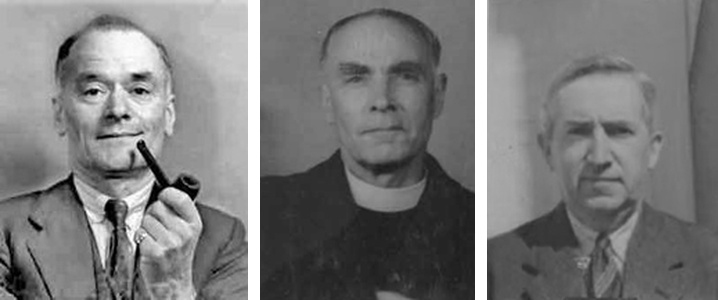 Philip Le Feuvre, Canon Clifford John Cohu and Wilfred ‘Bill’ Bertram. Pictures courtesy of Jersey Heritage.