Next week’s States Meeting
States Assembly
20 February 2026
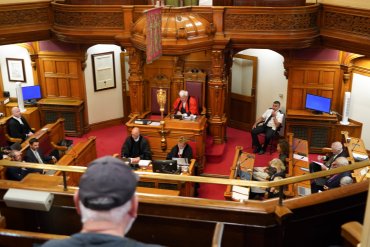
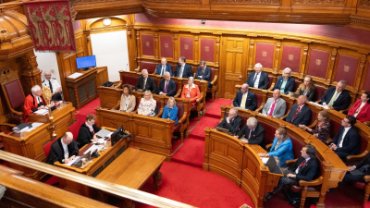
 On Tuesday 24 February, the next meeting of the States Assembly will commence at 9:30am. The meeting takes place in the States Chamber and is open for the public to attend, as well as being broadcast live on our website and on the States Assembly YouTube channel.
Oral Questions
States Members will question Ministers for up to 2 hours and 20 minutes. These oral questions are issued to them in advance (i.e. ‘with notice’). Details of next week’s oral questions with notice can be found on page 11 of the Order Paper.
The following Ministers will then answer oral questions which they have not been given in advance of the meeting (i.e. ‘without notice’) for 15 minutes each:
- Minister for Justice and Home Affairs, Deputy Mary Le Hegarat
- Minister for Social Security, Deputy Lyndsay Feltham
- Chief Minister, Deputy Lyndon Farnham
The following Members will then make a statement to the Assembly:
- Deputy Helen Miles, Chair of the Parishes and Government Review Panel, regarding the publication of its report.
- Deputy Louise Doublet, Chair of the Assisted Dying Review Panel, regarding the publication of its report.
- Deputy Louise Doublet, Chair of the Health and Social Security Scrutiny Panel, regarding the publication of its Family Friendly Review report.
- Deputy Catherine Curtis, Chair of the Children, Education and Home Affairs Scrutiny Panel, regarding the publication of its Lifelong Learning Review report.
- Deputy Steve Luce, Minister for the Environment, regarding the phase-out of petrol and diesel vehicles from 2030, as set out in the Carbon Neutral Roadmap.
The States Assembly will then begin debating the following:
| Proposition: | More information: |
| P.47 Suspension of Deputy P. F. C Ozouf of St. Saviour | The Privileges and Procedures Committee is proposing to suspend Deputy Philip Ozouf for 28 days with immediate effect for breaching the States Members’ Code of Conduct. It follows the Deputy’s conviction and sentencing by the Royal Court for assisting unlawful immigration. Please note: The Assembly will need to agree to reduce the minimum lodging time if the proposition is to be debated at this meeting. |
| P.65 Draft Assisted Dying (Jersey) Law | The Council of Ministers is proposing to introduce a law which would allow a person who has a terminal illness and who is experiencing, or expected to experience, unbearable suffering to choose to end their life with the help of a medical professional. They must:
Please note: The Assembly agreed to adopt the principles on 26 November 2025. Debate will resume with consideration of the individual Articles, and amendments will be taken in order of where they appear within the draft law. |
| Deputy Barbara Ward is proposing an amendment to remove a waiver in the proposed law which currently allows an individual to decide in advance that, if they lose decision making capacity after their request is approved but before providing final consent, their assisted death can still take place. | |
Deputy Tom Binet, the Minister for Health and Social Services, is proposing an amendment to clarify the wording and intent of the law in relation to areas including:
|
|
| The Assisted Dying Review Panel is proposing an amendment that would require a person approved for an assisted death to administer the medication themselves or, in cases where there is reduced physical capacity, for all necessary resources to be provided to enable self-administration. A practitioner would be permitted to administer the medication only in cases where there is severe physical incapacity. |
|
| The Assisted Dying Review Panel is proposing an amendment that would prevent any third parties from appealing against a decision to allow an assisted death. Appeals would only be permitted from the person requesting the procedure. | |
| The Assisted Dying Review Panel is proposing an amendment to refine the offence of coercion by replacing the term ‘dishonesty’ with ‘maliciously’ to ensure only harmful and improper influence is covered. The amendment also changes the severity of punishments. Whilst coercing someone into an assisted death would still carry the maximum 14-year prison sentence, coercing someone out of an assisted death would carry a lower-level penalty, limited to a fine, reflecting the ethical and practical difference between the two forms of coercion while ensuring both are clearly prohibited. |
|
| The Assisted Dying Review Panel is proposing an amendment that written information relating to the service should only be provided in GP surgeries within a clinical setting and only when a health professional is present. This is to ensure that explanations and signposting to services such as palliative care can be provided at the same time. | |
| The Assisted Dying Review Panel is proposing an amendment to ensure training and guidance explicitly covers identifying coercive control, domestic abuse, emotional abuse, financial abuse and other forms of undue influence. The amendment also aims to ensure this training is provided on an ongoing basis. |
|
| The Assisted Dying Review Panel is proposing an amendment that requires a review of how the service is operating is carried out within three years of it becoming fully operational. It also requests that disability groups and representatives are consulted as part of any implementation or post-implementation review. | |
| The Assisted Dying Review Panel is proposing an amendment that requires the Minister for Health and Social Services to present an annual report to the States Assembly. This report should detail the operation of the service, the effectiveness and compliance of safeguards, identify any emerging issues and provide recommendations to support its improvement. | |
| P.85 Draft Marriage and Civil Partnership (Dissolution and Separation) (Jersey) Law |
Deputy Mary Le Hegarat, the Minister for Justice and Home Affairs, is proposing to establish the principle of 'no fault' dissolution for both marriages and civil partnerships. This will permit both parties to apply for a dissolution; remove the ability to contest a dissolution application; enable future consideration to be given to pension matters, including 'pension sharing'; and allow the Court to refer couples to alternative dispute resolution services. It would also do away with the minimum time period of three years before a marriage dissolution can be sought. The Law has been written to modern drafting standards and includes provision for civil partnerships so that both types of union are dealt with in the same place. Please note: The Assembly agreed to adopt the principles on 26 November 2025. Debate will resume with consideration of the individual Articles, and amendments will be taken in order of where they appear within the draft law. |
|
|
Deputy Mary Le Hegarat, the Minister for Justice and Home Affairs, is proposing an amendment that introduces minor technical changes to improve certain provisions of the Law, following queries raised by the Children, Education and Home Affairs Scrutiny Panel. These amendments are largely editorial in nature and are intended to enhance the overall effectiveness of the proposed Law. |
| P.112 Draft Alcohol Licensing (Jersey) Law |
Deputy Kirsten Morel, the Minister for Sustainable Economic Development, is proposing changes to Jersey’s alcohol licensing regime to reduce the complexities and speed up the process. Under the proposals:
Please note: The Assembly agreed to adopt the principles on 22 January 2026. Debate will resume with consideration of the individual Articles, and amendments will be taken in order of where they appear within the draft law. |
| The Comité des Connétables is proposing an amendment to allow Constables to act as the determining authority for alcohol applications within their parish, rather than the proposed Alcohol and Gambling Commission. | |
| Deputy Alex Curtis is proposing an amendment requiring licenced premises to provide customers with free tap water, unless it cannot be supplied easily. | |
| Deputy Sir Philip Bailhache is proposing an amendment to retain the Licensing Assembly as the body which approves applications for liquor licences. It does not reinstate the current number of categories and accepts the proposal to reduce those to three. | |
| Deputy Kirsten Morel, Minister for Sustainable Economic Development, is proposing an amendment that would move oversight of alcohol licenses to the Regulation Directorate instead of the proposed Alcohol and Gambling Commission. The amendment also sets out the membership of the Alcohol Policy Board and the key objectives it must deliver and removes proposals to introduce civil penalties. |
|
| P.121 Draft Heritage (Jersey) Law | Deputy Kirsten Morel, Minister for Sustainable Economic Development, is proposing a new law to set out the legal obligations for reporting, recording, investigating and preserving objects and sites of archaeological significance. If approved, the law would also:
|
| P.122 Draft Treaties (Jersey) Law | The Chief Minister is proposing a new law that would require any international treaties entered into by Jersey, or applied or extended to the Island, to be presented to the States Assembly before coming into force. This follows a States decision in 2023 to introduce such a law. |
| The Chief Minister is proposing an amendment to remove the requirement for a treaty signed by the Attorney General for law enforcement purposes to be presented to the Assembly. | |
| P.12 Amendments to Standing Orders – Miscellaneous amendments | The Privileges and Procedures Committee is proposing amendments to Standing Orders to allow for the inclusion of Senators. The proposition asks to add Senators to the roll call; identify how they should be addressed within Assembly proceedings; and to allow newly elected Senators to sign nomination forms for candidates seeking to be Chief Minister. It also seeks to remove the rule that allows for any time not used during the first two periods of Questions Without Notice to be rolled over to the third period with the Chief Minister. |
| P.19 Capping the Number of High-Net-Worth Individuals granted Entitled status | Deputy Jonathan Renouf is proposing to limit the number of High Value Residents granted entitled residential status to 15 per year, or 75 in any 5-year rolling period. If approved, the changes would be introduced by the end of March 2026. |
A notification when each debate begins, a summary of the Proposition and the results of each debate will be shared on the States Assembly X page (formerly Twitter) throughout the meeting.
A summary of the meeting will be shared at the end of each day on the news section of the States Assembly website. A summary of the voting for each individual Member and Proposition is also available on our votes page.