
Briefing Paper: Firearm Controls
This content has been automatically generated from the original PDF and some formatting may have been lost, therefore it should not be relied upon to extract citations or propose amendments. Please see the PDF for the official version of the document.

Introduction
The Firearms (Jersey) Law 2000 (the “2000 Law”) was a significant piece of legislation that introduced drastic changes to the certification and framework around the owning of firearms in Jersey. Since its introduction in 2000, there have been a few developments to make the law tighter and more fit for modern purpose. the law and the policies surrounding it.Controls on firearms prior to the 2000 Law
Prior to the introduction of the 2000 Law, firearm ownership was governed by the Firearms (Jersey) Law 1956 (the “1956 Law”). The 1956 Law was an initial attempt to consolidate local rules and introduced a partial licensing system.The 1956 Law introduced limited controls over rifles and pistols but mostly focussed on the use of shotguns on and off private land. The main focus being that if a shotgun was owned and used on private land there was no need to register the firearm or obtain a certificate. This had the consequence of authorities not having an accurate record of how many shotguns were owned.
For shotguns used outside land owned by the person with the firearm, a permit known as a Port d’Armes was required. This was outlined in the Loi (1879) sur le Port d’Armes (the “Loi”) and was to be issued by the Connétable of the relevant parish. However, it appears that checks were inconsistent and once authorised there were no clear powers in the either the 1956 Law or the Loi to revoke the Port d’Armes.
The checks involved with the issuing of a Port d’Armes were undertaken by the Connétable of each parish with no police involvement. This meant that each parish applied its own standards to whether a shotgun owner could be granted the permit.
The 1956 Law also outlined controls for the ownership of pistols and rifles similar to contemporary controls in the UK. These required a Firearm Certificate, still issued at parish level. This certificate did accurately record the firearms held as well as whether the owner bought further firearms or disposed of any. However. as this was also regulated by the parishes there remained a lack of consistent policy or central database.
By the 1990s the 1956 Law was considered outdated and problematic due to the limited oversight of shotguns and the unknown number of those owned on private land. The limited powers to revoke permits once given also raised problems.
Firearms (Jersey) 2000 Law
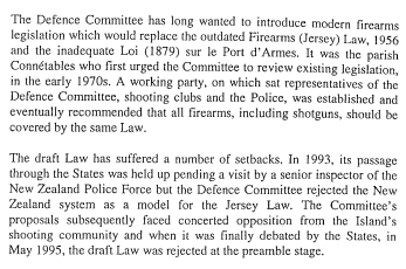
Efforts to update Firearms legislation began in the 1990s due to the above-mentioned issues as well as the development of new type of firearms. Legislative changes were also taking place in the UK after the Dunblane Massacre, and the 1956 Law was becoming increasingly outdated raising concerns for public safety.The Defence Committee brought the Draft Firearms (Jersey) Law 199- (P.161/1993) to the Assembly in 1993, however this was not successful. The preamble to the successful 1999 iteration of the Law explains the history –
Source: P.96/1999
The Firearms (Jersey) 2000 Law was adopted on the 17th November 1999 (P.96/1999) and came into force on 1st November 2001 (the “2000 Law”).
At the core of the new law was a single legal framework that covered the manufacture, purchasing, possession, transfer, and use of firearms and ammunition. The biggest change this introduced was the requirement for the same level of Firearms Certificates for all types of firearms, including the previously less controlled shotguns. The certificates were also required for most types of ammunition.
The licensing authority for these certificates remained with the Connétable of the relevant parish. Despite retaining the power to issue certificates, a centralised criteria was introduced that each Connétable had to follow in order to determine whether an individual could be granted a certificate. The criteria introduced in the 2000 Law also included proof of safe storage and the introduction of a vetting process to ensure the individual was a “fit and proper person”.
Amendments to the 2000 Law
In 2006 a Government review was launched with the remit of examining how the new Law was working. It focussed on the number and types of firearms in circulation and the licensing procedures, specifically the consistency across parishes. The executive summary of this report outlined the following points and recommendations –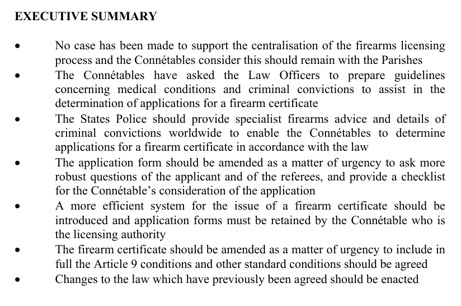
Following the publication of this report, work began to address these recommendations including the gaps in weapon definitions, in particular the difficulties that existed in prosecuting an individual for the possession of knives without intent to cause harm.
2008 saw the most significant amendments introduced to the 2000 Law, with a focus on clarification of issues identified in the Law as it was, rather than replacing it. The Firearms (Amendment No. 2) (Jersey) Law 2009 was adopted on 3rd December 2008 and came into force on 13th May 2009.
The amendment was brought by the Government to correct several issues that had been noted since the introduction of the 2000 Law that required legislative amendments to solve, such amendments intended to make the Law clearer and easier to enforce. The amendments were far ranging, however some of the key amendments –
- Clarified who was responsible for the granting, varying, and revocation of firearms licenses.
- Confirmed the central role of the Connétable whilst also introducing mechanisms where conflicts arise (for example if the Connétable is involved personally).
- Introduced hunting licenses for pest control during daylight hours and linked the law more closely with the Conservation of Wildlife (Jersey) Law 2000.
- Provided the police with further powers to enter schools without a warrant to search for bladed items.
- Removed strict control around certain low-risk items such as flare guns and low-powered air weapons.
- Adjusted definitions of permitted ammunition to avoid common ammunition types being accidentally prohibited.
- Clarified that conditions attached to firearms certificates can be appealed.
Policy Changes in the 2020s
The amendments made the 2000 Law more legally robust and easier to enforce, however, they did not significantly tighten gun-control. Following the adoption of these amendments, the law remained unchanged for nearly 20 years.However, throughout the 2010s and into the 2020s there were growing concerns on the number of firearms per person in jersey, and the change in public expectations for the vetting and requirements for a firearms certificate. The Minister for Home Affairs at the time stated this came in the wake of the Plymouth Shootings of 2021.
In 2024, the new Minister for Home Affairs stated that there would be no full review into the 2000 Law and no planned date for any future review. Despite no plans for legislative changes, the Minister did intend to bring changes through the tightening of policy.
In her answer to Written Question 352/2025, the Minister stated that the Police would work with a group of Connétable s to introduce policy changes based on risk instead of a full legal review. The policy areas would include –
- Continuing to apply the policy that a person must have good reason to possess each firearm and to acquire additional firearms, i.e. "Wish Li sts" are not granted.
- All licences to be issued without ammunition, the applicant to apply for the addition of ammunition which will only be permitted if there is " Good Reason" to possess, i.e. an applicant will not automatically be granted up to 5,000 rounds.
- Requirement for applicants to evidence membership of an approved shotting club, only those who are members and regular attendees will have good reason to possess ammunition.
- Review and improve the medical referee process.
- Consider requiring referees to be the holder of a Firearm Certificate.
The States of Jersey Police provided a submission to Scrutiny on this matter, within which they stated that there should be zero ammunition allowed at home due to the remaining risk of a lone-actor incident.
Comparisons of the Jersey Law and the UK Firearms Acts
| Area | Jersey (Firearms (Jersey) Law 2000) | United Kingdom Firearms Acts |
| Type of system and relevant Li censing authority | Decentralised system administered by Parish Connétable s | Centralised national system administered by police forces |
| Certificate requirement and ammunition control | A certificate is required for almost all types of firearms and a separate authorisation for ammunition | Required for firearms and most controlled weapons; ammunition normally authorised within certificate limits |
| “ Good reason” test | Required, now applied more strictly | Required under UK law (longstanding principle) |
| Storage requirements | Legal duty for secure storage | Strict Home Office guidance alongside legal duty |
| Li cence duration | Usually 5 years | Usually 5 years |
| Appeals | Appeals to the Royal Court which was clarified in the 2008 amendments | Appeals to the Crown Court |
| Visitor permits | Required for all firearms including air weapons but no sponsor needed | Visitor permits available for those that do not hold a UK certificate but a sponsor who lives in the UK is needed |