
Briefing Paper: Road and fuel emission duty
This content has been automatically generated from the original PDF and some formatting may have been lost, therefore it should not be relied upon to extract citations or propose amendments. Please see the PDF for the official version of the document.
OverviewThis paper sets out the development of road and fuel emission duty on the Island, providing comparators to other jurisdictions, and details the development of vehicle safety and roadworthy tests in Jersey |
 |
Introduction
The first motor car arrived in Jersey just before the end of the 19th century. The Jersey Express of 31st July 1899 reported the arrival of a phaeton-built car, constructed by the International Motor Company in London, for Peter Falla , a solicitor.[1]In 1920, within 20 years of the arrival of the first motor car in the island there were an estimated 4,000 motor vehicles registered in Jersey. By 1936 the Motor Traffic Office was opened and driving tests were carried out.[2]
The Motor Vehicle Duty (Jersey) Law 1957 was approved by the States Assembly on 4th April 1957, coming into force on 1st January 1958 (the “1957 Law”). The 1957 Law set out that –
“there shall be charged in respect of mechanically propelled vehicles used on public roads in the Island such duties as the States shall by Regulations provide”.
Motor Vehicle Duty
Further to the implementation of the 1957 Law in 1958, charges came into force through the Motor Vehicle Duty (Jersey) Regulations 1966 – which set out the amount to be charged per vehicle. At the time of adoption, for example, a motor bicycle of less than 250CC would have cost the owned 50 shillings a year – an additional 10 shillings being due if it had a sidecar attached.Motor Vehicle Duty was abolished in December 1993 through the adoption of the Motor Vehicle Registration (Jersey) Law 1993 (the “1993 Law”) which dictated the registration method of all vehicles but removed the requirement to pay Motor Vehicle Duty. This change resulted in an annual loss of £1.3 million.
To offset this loss, in the 1994 budget an additional 2.56p of Impôts (excise) duty was added per litre of unleaded petrol and an extra 0.85p excise duty was added per litre of diesel. This resulted in additional yield in 1994 of £1.31 million from fuel duty.
This additional yield in duty was not ring-fenced specifically for the maintenance of roads, or any other infrastructure requirements. All taxes and duties are paid into the central fund, with the States Assembly approving expenditure through the annual Budget process.
VRD and VED
Vehicle Registration Duty (VRD) was introduced in 2003 but was abolished in May 2008 to avoid double taxation upon the introduction of a Good s and Services Tax (GST) in 2008.The removal of VRD was also linked to the investigation by the States, into potential environmental taxes on waste, motor transport and energy – the Minister for Planning and Environment having been tasked with advising on an environmental tax that could replace VRD.[3]
Whilst it was decided not to rush the introduction of such taxes, the Customs and Excise Annual Report from 2007 notes that the Minister for Treasury and Resources intended –
“to bring legislation before the States to allow for a replacement for VRD, to commence at the same time as the introduction of GST. This replacement will base the duty liability on vehicles Carbon Dioxide - CO2 - emissions rather than engine size. The liability will occur on the date of first registration in Jersey, as is currently applicable under VRD.
Manufacturer's CO2 emission data is not available for all vehicles therefore the duty liability for vehicles without CO2 emission data will be calculated on engine size.”
This set the groundwork for Vehicle Emissions Duty (VED). The following table presents the changing revenue from both VRD and VED.
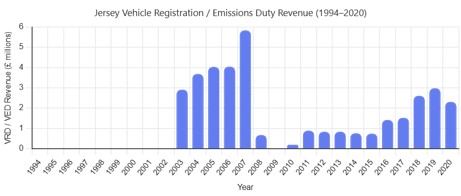
(data obtained from gov.je Impôts and other duties receipts)
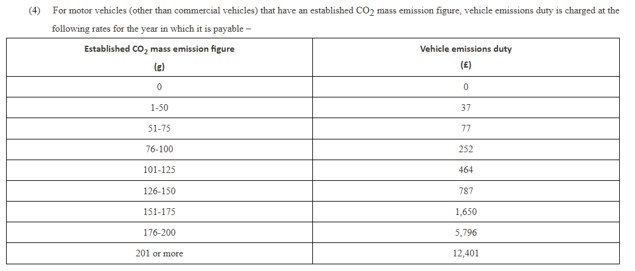
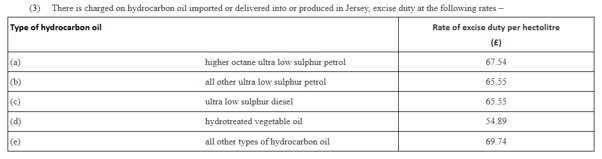
VED is defined, and charge rates established, through the Customs and Excise (Jersey) Law 1999 (as amended).
-Law-1999.jpg "Clip-from-Customs-and-Excise-(Jersey)-Law-1999.jpg")
It is important to note that VED is only payable on the first occasion when the relevant vehicle is registered under Article 4 of the Motor Vehicle Registration (Jersey) Law 1993.
The amount of VED payable depends on the vehicle’s CO2 emissions data, meaning that the charges are higher for the most polluting vehicles. Income from higher VED rates on polluting vehicles goes directly into Jersey's Climate Emergency Fund.[4]
Fuel Duty
Fuel prices in Jersey include a high duty component, which partially serves as a substitute for annual road tax.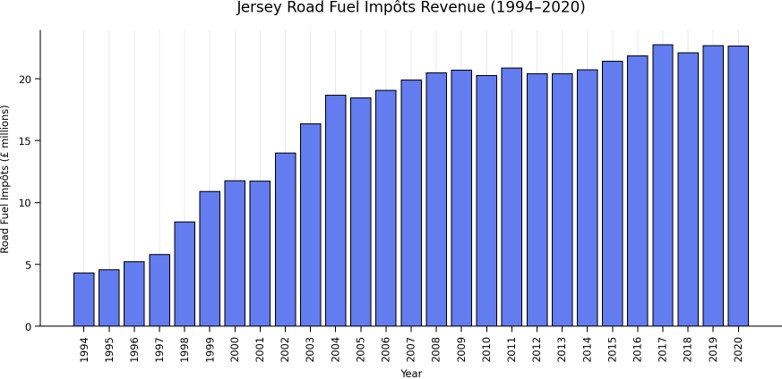 (data obtained from gov.je Impôts and other duties receipts)
Fuel Duty is prescribed through the Customs and Excise (Jersey) Law 1999, with any changes forming part of the annul Budget discussions of the States Assembly. Fuel Duty was frozen between 2023-2025 to assist with the cost of living pursuant to a successful amendment to the Government Plan 2024-2027, lodged by the Economic and International Affairs Scrutiny Panel. However, the 2026 Budget returned to the practice of indexing fuel duty with RPI growth to maintain its value in real terms. This resulted in an increase of 2.6% to £65.55 per hectolitre (100 litres).
Fuel Duty Replacement Policy
The Budget (Government Plan) 2026-2029 (P.70/2025) set out the Government’s consideration of“The vehicles seen on Jersey’s roads are changing in response to global carbon reduction ambitions and an evolving global market. In response to Government policies and Islanders’ own choices, receipts of road fuels duty are expected to decline.
However, it will still be necessary for the Government to meet the costs of road maintenance and improvement along with the wider costs arising from road and vehicle usage.
The income currently earned from road fuels duty will also be needed to support wider policy initiatives, such as the sustainable transport policy and the Carbon Neutral Roadmap, as well as contributing to the funding of other essential services.
In time, alternatives will need to begin making up the funding lost from declining fuel duty. Alternative charges may include a form of vehicle ownership charge and a road user charge. Ministers decided to pause work in 2024 on the basis that the data showed that fuel duty receipts were in steady decline only. The position will remain under review.”
In April 2026 the Government published their report into a consultation on the phasing out of petrol and diesel vehicles. The consultation ran from 6th November 2025 to the end of January 2026, asking Islanders and businesses to respond to proposals that would have been implemented from 2030.
The Minister for the Environment stated that –
“After considering economic advice and the findings of the consultation, I have concluded that we do not need to create costly new legislation, as the changes in the UK will cascade to the local market automatically. I therefore will not be introducing limitations on the importation and registration of fossil fuel vehicles.”
The related statement of the Minister for Treasury and Resources showed that work on Fuel Duty replacement options remained paused at the end of the previous Government’s term of office –
“I am keenly aware that fuel duty revenues will decrease as motorists switch to more efficient forms of transport. During my term in office, we have developed options for replacing fuel duty, including looking at a vehicle ownership charge and a road usage charge.
“Throughout this period, we have also been carefully monitoring both fuel consumption and fuel duty receipts. On the basis that revenues are in steady decline only, we took the decision to pause the fuel duty replacement work.”
Vehicle Tax in Other jurisdictions
Vehicle taxation applies to most types of vehicles and is applicable a large number of jurisdictions, with variances on name and purpose.This can cause some confusion – for example vehicle tax in the UK is called Vehicle Excise Duty (UK VED). UK VED is an annual tax paid to the government for using a vehicle on UK roads. It is sometimes still called “road tax”, even though it no longer directly pays for road maintenance. It should not be mistaken for Jersey VED which is a one-off payment on registration of a vehicle.
Vehicle Tax varies significantly between jurisdictions. Some countries charge annual ownership taxes, while others rely mainly on registration fees, fuel taxes, or emissions-based charges –
| Jurisdiction | Tax Type | Basis of Tax | Example/Notes |
| United Kingdom | Vehicle Excise Duty (VED) | CO emissions and vehicle type | Newer vehicles pay according to emissions bands. |
| Isle of Man | Vehicle Tax | CO emissions and vehicle type | Annual tax. All electric cars pay a flat rate. |
| Guernsey | First Registration Duty (matches the Jersey VRD) |
Applies to new and second-hand vehicles being imported and registered in Guernsey for the first time | Guernsey is currently bringing in a new annual vehicle tax, with a corresponding reduction on Fuel Duty. |
| Germany | Kraftfahrzeugsteuer | Engine size and CO emissions | Annual tax for registered vehicles. |
| France | Malus écologique | CO emissions | High-emission vehicles can incur substantial one-off registration taxes. |
| New Zealand | Road User Charges (certain vehicles) | Distance travelled and vehicle type | Particularly applies to diesel vehicles. |
| Ireland | Motor Tax | CO emissions or engine size | Emissions-based system for most modern vehicles. |
| Netherlands | Motorrijtuigenbelasting | Vehicle weight and fuel type | Provincial surcharge also applies. |
Vehicle Safety and Roadworthy Tests in Jersey
Currently, there are no requirements for van and car drivers to have periodic safety and roadworthy tests (similar to the UK MOT system) undertaken on their vehicle – and the possible implementation of inspections on these types of vehicles in Jersey has been pushed back until 2028. However, in 2019 Periodic Technical Inspections (“PTI”) were introduced in the Island for motorcycles 125cc and below.
Further to the impact of Brexit the 2018 Minister for Infrastructure brought draft regulations (P.109/2018) to the Assembly, setting out proposals to bring the Island in line with the road traffic requirements of the Vienna Convention. The intention being –
“To secure the rights of Jersey motorists and vehicles to freely circulate within the EU, without hindrance following Brexit”.
Prior to the debate on P.109/2018 the Environment, Housing and Infrastructure Scrutiny Panel held a hearing on 30th October 2018 to assess whether contracting to the United Nations Vienna Convention on Road Traffic is the best solution for Jersey to guarantee the free circulation of vehicles in Europe post-Brexit, or if there are suitable alternative options. The Panel reported in it’s Comments paper that “Following a detailed investigation within the short and limited timescale available, the Panel is satisfied that no other option other than contracting to Vienna would entirely guarantee that Jersey motorists would be able to circulate across all of Europe post-Brexit.”. Constable Mike Jackson, Jersey's Environment, Housing and Infrastructure Scrutiny panel chair, went on to states in a Channel TV interview that “the Government is doing the "right thing" but it is possible that Jersey is acting too soon”.[5]
P.109/2018 was adopted by the Assembly – pursuant to which it was accepted that a phased approach would be required - at least in relation to periodic technical inspections (“PTI”), as the Island did not have the necessary infrastructure or capacity to meet the anticipated need.
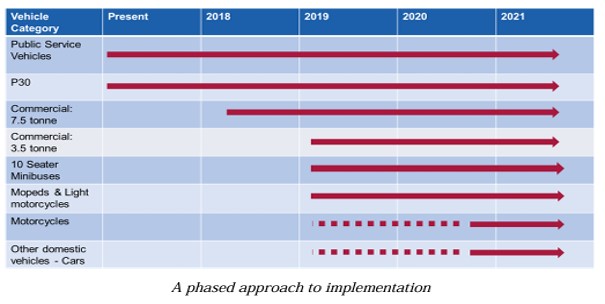
In February 2019, the Minister for Infrastructure made the Road Traffic (Periodic Technical Inspections – General Provisions) (Jersey) Order 2018, setting out the operation of the PTI regime in more detail. This set out the deadline of 30th March 2021 for the commencement of PTI on domestic vehicles.
In March 2021 this was updated to 2024, and in April 2024 the Minister for Infrastructure again updated the Order to March 2028, after he acknowledged that the Island could not meet the deadline.
Vehicle inspections in Jersey – other vehicles
| Vehicle Type | Inspection Requirement | First Inspection Due | Subsequent Inspections | Exemptions / Notes |
| Motorcycles and mopeds | Periodic Technical Inspection (PTI) required. | 2 years after first use. | Every 2 years after the vehicle is 3 years old. | Applies to motorcycles and mopeds registered in Jersey. |
| Minibuses | Periodic Technical Inspection (PTI) required. | First anniversary after first use. | Annually. | Inspections carried out by Driver and Vehicle Standards (DVS). |
| Commercial goods vehicles over 3.5 tonnes GVW | Annual Roadworthiness Inspection (ARI) required. | Within the first inspection period specified by DVS. | Every 12 months with a valid Certificate of Compliance (CoC). | Applies to commercially operated medium and heavy goods vehicles. |
| Commercial goods vehicles over 7.5 tonnes GVW | Annual Roadworthiness Inspection (ARI) required. | Required before operation under the scheme. | Annually. | Includes heavy goods vehicles used for trade or business purposes. |
| Commercial trailers (over 1,020 kg unladen weight) | Annual Roadworthiness Inspection (ARI) required. | Before operation under the scheme. | Annually. | Includes semi-trailers and drawbar trailers. |
Data compiled from the Road Traffic (Periodic Technical Inspections – General Provisions) (Jersey) Order 2018 and information available on Gov.je.
Vehicle Safety and Roadworthy Tests in other jurisdictions –
- In the UK, once a vehicle is three years old, it must pass an MOT test every year.
- In France[6], Spain[7] and Italy[8], a roadworthiness test (the test names vary) must be carried out on vehicles when they reach four years old and renewed every two years.
- Germany requires vehicles to undertake a Hauptuntersuchung (HU), colloquially known as TÜV (after the inspection organisation)[9], commencing after a car is three years old. Cars then receive a TÜV sticker – this is coloured sticker on the rear licence plate which shows when the next inspection is due. An expired sticker is therefore immediately visible to police.
[3]Customs and Excise Annual Report 2007 https://edit.gov.je/SiteCollectionDocuments/Government%20and%20administration/R%20Customs%20and%20Immigration%20Annual%20Report%202007%2020080414%20JCIS.pdf
[4] Budget (Government Plan) 2025-2028 https://www.gov.je/SiteCollectionDocuments/Government%20and%20administration/Budget%202025%20to%202028.pdf