
Letter - Director General of Strategic Policy, Planning and Performance to Public Accounts Committee re Review of Citizens' Panels, Assemblies and Juries - 24 November 2021
This content has been automatically generated from the original PDF and some formatting may have been lost, therefore it should not be relied upon to extract citations or propose amendments. Please see the PDF for the official version of the document.
19-21 Broad Street | St Helier Jersey | JE2 3RR
Deputy Inna Gardiner Chair
Public Accounts Committee By email
24 November 2021
Dear Deputy Gardiner ,
PAC Review of Citizens' Panels, Assemblies and Juries
Thank you for your letter of 5 November regarding the Public Accounts Committee's review of Citizens' Panels, Assemblies and Juries. I have sought to answer your questions both in this letter and in an accompanying table. You will note that both documents refer to the
three deliberative exercises that were led by the Department for Strategic Policy, Planning and Performance (SPPP) – these being:
• Care Inquiry Legacy Citizens' Panel;
• Jersey's Citizens' Assembly on Climate Change; and
• Assisted Dying Citizens' Jury.
I understand you will have directed questions regarding the Our Hospital Citizens' Panel to the Director General of Infrastructure, Housing and Environment as lead for the Our Hospital project.
I am also pleased to enclose (in the appendix to this letter) the additional information about the Citizens' Assembly on Climate Change that was requested by your officers on 18 November, and that had previously been provided to the Environment, Housing and Infrastructure Scrutiny Panel following the publication of their Observers' Interim Report (S.R.10/2021) on 19 July 2021. This helpful report covers many of the questions your Committee has raised and I have cross-referenced my answers to that report where appropriate.
Similarly, many of the areas that are of interest to the Committee are addressed in published reports of the two other panels, specifically: Jersey Citizens Panel 2018 - Final Report.pdf
(gov.je) and the Final Report from the Jersey Assisted Dying Citizens' Jury.
I have also been able to draw on the existing correspondence between PAC and both the current and previous Chief Executives. These letters also helpfully cover issues that are pertinent to the Committee's current review.
In particular, I would like to echo the Chief Executive's view, expressed in his letter to you of 6 September, that "this is an area of emerging practice, where Jersey is showing leadership and experimenting with different formats and approaches to support ministers and the States Assembly to improve public policy making. As suchattempt(s) by the government to assess the efficacy of these innovative methods is therefore also emerging practice."
I hope this response is of assistance to the Committee and am content for this to be published should the Committee wish to do so.
Yours sincerely,

Tom Walker Director General E t.walker@gov,je
cc: Chief Executive
Questions and Answers
- Please can you explain the Government of Jersey's work in establishing and supporting each of the Citizens' Panels, Assemblies and Juries to date?
The previous Chief Executive wrote to the Committee on 2 February setting out details, for each deliberative exercise, of the:
• Area of focus
• Number of participants
• Selection method
• Lead and support roles
• Period and duration
• Costs, and
• By whom it was commissioned.
Officers in SPPP have reviewed and updated this information, where relevant, which is contained in the spreadsheet that accompanies this letter. Additional questions asked by PAC have been added to that spreadsheet with the question number included in the column header for ease of reference.
- What departmental resources and officer support were provided to facilitate each Citizens' Panel, Assembly, and Jury? Please can you include in this answer a breakdown of Officer FTE's, departmental funds, and include information on the logistics used for the facilitation of these bodies.
Budgets and an assessment of officer resource are enclosed in the accompanying spreadsheet.
- How were Officers resourced by the department to facilitate these bodies?
- How did you determine the number of FTE's and other resources needed to facilitate the Panels, Assembly and Jury?
Officer resource was estimated as part of the project development and then kept under on-going review.
Allocating officer resource to government priorities is a mainstream management responsibility and happens as part of business as usual on a daily and weekly basis.
- What training did Officers with responsibilities for these bodies receive in improving their understanding of how these bodies operate and influence policy development/decision- making?
Experiences from other deliberative exercises was researched and considered in commissioning these exercises. The contracted expert partners also provided relevant expertise and on the job' training for Government of Jersey officers. Some exercises also included more formal training in, for example, relevant facilitation skills.
The influence of deliberative processes on policy development and decision making is not uniform, and so opportunities to learn focused more on good process management
and execution than on predicting' what the impact might be on existing democratic processes.
- What resources were provided to improve the understanding of States Members and the public on how these bodies work?
Different deliberative exercises took different approaches to sharing their work in order that others might understand it. Measures included publishing Terms of Reference, briefings to relevant Scrutiny Panels (including allocating observer status to the Environment, Housing and Infrastructure Scrutiny Panel in the case of the Citizens' Assembly on Climate Change) and publication of information about selection methods and other matters.
- What internal definitions are used by the Government of Jersey to establish the differences between a Citizens' Panel, Assembly and Jury, and other terminology used for these bodies? How were these developed?
The Government of Jersey (GoJ) has relied on external practitioner definitions, such as those published at https://www.involve.org.uk/resources/methods.
- What decision-making processes were used by Officers to agree upon and establish each Citizens' Panel/Assembly/Jury and draft business cases for the respective Minister(s) to approve?
This is addressed in the accompanying spreadsheet.
Each deliberative exercise was established by a political decision. In making those decisions, ministers were advised by officers based on the research and professional understanding about the potential for a deliberative process to help ministers to achieve their stated aims.
- Please could you provide to the PAC with the budget for each Citizens' Panel, Assembly and Jury, a full breakdown of the spend by the Government of Jersey on each Panel, Assembly and Jury (including a clear outline of departmental spend and what spend was provided to external organisations/facilitators).
This is addressed in the accompanying spreadsheet.
- How were budgets developed for each Citizens' Panel/Assembly/Jury? Please could you include a table on the original budget/business case for each, the final cost breakdown, and any outstanding costs. (We did receive previous costs on the Climate Panel but we would like an update).
Policy development exercises do not usually require the development of a business case. Research, analysis, consultation and other similar exercises that are necessary to support ministers to formulate policy are commissioned as part of business-as-usual management activity.
- What, if any, liaison you had with other jurisdictions to improve your understanding of the potential cost and resources required for the facilitation of each Citizens' Panel/Assembly/Jury?
This is addressed in the accompanying spreadsheet.
- The PAC received a letter from the Chief Executive on 6th September 2021 that indicated that the Climate Conversation Citizens' Assembly had exceeded its budget. Why was this the case, and what lessons have been learnt from this?
Having reviewed the relevant correspondence, I believe that this was raised in the Chief Executive's letter of 11 May. That letter also contained the following explanation of this issue, which remains accurate:
"In addition, there has also been a small increase in the core cost' identified in the letter of 2 February, as Citizens' Assembly members requested an additional session in order to have more time to consider their recommendations. This creates further costs, such as additional honoraria for Citizens' Assembly members, facilitator time and support for Citizens' Assembly members. In addition, throughout the process there have been some additional necessary Advisory Panel sessions and a slightly greater use of paid expert speakers in order to meet the context requirements."
A reasonable conclusion would be to provide an element of contingency in future budgets in case other deliberative exercises generate the need for additional sessions.
- What processes have been developed to deliver any future Citizens' Panels/Assemblies/Juries within budget?
Budget management is business-as-usual management activity, and no additional processes were necessary to accommodate these exercises.
- Please could you provide a comprehensive overview of how each Citizens' Panel, Assembly and Jury was facilitated, including stakeholder engagement and the work officers undertook to develop reports and other policy resources resulting from the work of these bodies?
These matters are addressed by the following published reports:
• Jersey Citizens Panel 2018 - Final Report.pdf (gov.je)
• Observers' Interim Report on Citizens' Assembly Process (gov.je)
• Final Report from the Jersey Assisted Dying Citizens' Jury.
Officers in the Department would be very happy to answer any further supplementary questions the Committee might have.
- What involvement did your department and the wider Government of Jersey have in the operation of each Citizens' Panel/Assembly/Jury?
- How were participants selected for each Panel/Assembly/Jury? What involvement did the Government of Jersey and its respective departments have in this?
- How were advisors and stakeholders identified and contacted to support each Citizens' Panel/Assembly/Jury?
These questions are addressed in the accompanying spreadsheet.
- Which organisations have you worked with to facilitate Citizens' Panels, Assemblies and Juries?
a. What procurement processes were used to arrange partnerships with Contact Consulting, Peter Bryant, the Sortition Foundation, the New Citizenship Project, Involve.org, Chair for theOur hospital Citizen panel and any other organisations? How were contracts awarded?
This is addressed in the accompanying spreadsheet.
- Did you issue Service-Level Agreements with these organisations (including Contact Consulting, Peter Bryant, the Sortition Foundation, the New Citizenship Project, Involve.org) Chair for the Our hospital Citizen panel? If so, please could you provide in confidence a copy of these agreements to the PAC.
This is addressed in the accompanying spreadsheet.
a. If you did not issue Service Level Agreements, will you for future Citizens' Panels, Assemblies and Juries?
It is not known whether there will be further deliberative exercises commissioned, or the nature of those exercises and their requirements for external support. However, it is likely that a contract for professional services would continue to be the most appropriate form of agreement given the nature of the work.
- Please could you provide a breakdown of the recruitment methodology and selection criteria used for each Panel, Assembly and Jury, and outline which external organisations were used to aid in the recruitment and selection of participants?
- What recruitment processes were used for the Citizens' Assembly and Citizens' Panels, including for the selection of Chairs?
- How did you ensure that all processes were fair and transparent?
The recruitment to each of the deliberative bodies is addressed in the accompanying spreadsheet.
In addition, the details of the recruitment of the Chair-Convener to the Citizens' Assembly on Climate Change is fully addressed in the Environment, Housing and Infrastructure Panel's Interim Observer's Report.
- [N/A – relates to Our Hospital citizens' panel run by Infrastructure, Housing and Environment.]
- Please could you provide the breakdown of the recruitment and selection of participants as undertaken by the Sortition Foundation for all Panel's, Assemblies and Juries that it has been involved with.
As previously reported to PAC in the Chief Executive's letter of 2 February, the Sortition Foundation supported two deliberative processes:
• The details of the recruitment of participants in the Citizens' Assembly on Climate Change is fully addressed in the Environment, Housing and Infrastructure Panel's Interim Observer's Report.
• The details of the recruitment of participants in the Assisted Dying Citizens' is fully addressed in the Jury's final Report.
a. What corporate learning was developed regarding the recruitment and selection of participants through your work with organisations such as the Sortition Foundation during the facilitation of these bodies?
Sortition is a relatively simple concept and, other than the benefits of observing the practice, no specific additional insights were available.
- Overall, how could the transparency of the recruitment and selection of the Citizens' Panels, Assembly and Jury participants and chairs have been improved?
a. How would this be reflected upon in future Citizens' Panels/Assemblies/Juries?
The Chief Executive's letter of 6 September notes that:
"An evaluation of the Citizen's Assembly on Climate Change and the Citizen's Panel on Assisted Dying will be undertakenThat evaluation (which will begin in the Autumn) will consider at least two issues, to different timescales:
• Learning about the more mechanistic elements of the two exercises, including matters of cost and logistics, structure and process and the experiences of those involved. This aspect is expected to conclude by the end of 2021; and
• Learning about how these citizen processes worked with and influenced our existing policy making systems. There is no confirmed deadline for this aspect, as it can only be effectively undertaken once the related policy discussions (on carbon neutral and assisted dying) have concluded."
Learning about how the transparency of the recruitment and selection of the Citizens' Panels, Assembly and Jury participants and chairs might be improved falls into the first of these evaluations, and accordingly is expected to be available at the end of 2021.
Recruitment for the Care Inquiry Legacy Citizens' Panel in early 2018 was affected by
the challenges involved in reaching Survivors of abuse in care, due to there being no active community groups or peer networks in existence at that time. Appetite to participate in a Panel process launched by Government, despite independent expert facilitation being secured, was understandably tempered by low levels of trust in Government. The Care Inquiry Legacy Citizens' Panel process has resulted in the first steps to create a local Survivor-led Network.
- How did you facilitate, receive and process feedback from both participants and organisations you partnered with for these bodies?
a. What lessons have been learnt regarding stakeholder development and communication between these bodies and the Government of Jersey?
In respect of the Citizens' Assembly on Climate Change and Citizen's Jury on Assisted Dying, these issues will be addressed in the evaluation referred to above. The Oversight Group for the Care Inquiry Legacy Citizens' Panel has provided an ongoing forum to monitor the process and ensure effective communication. The Oversight Group will be considering the Panel's final report, which is due to be published before the end of 2021, and any learning arising from this.
- Was the Government of Jersey responsible for the administration of each Panel/Assembly/Jury, or was this handled by organisations such as Involve.org? If so, how were workloads and responsibilities agreed upon and monitored?
The Citizens' Assembly on Climate Change and Citizen's Jury on Assisted Dying were administered by a consortium of organisations and not by the Government of Jersey. The details of these external organisations are set out in the published reports referred to under question 11.
The Care Inquiry Legacy Citizens' Panel was administered by Contact Consulting (Oxford) Ltd.
a. What consideration or work has been undertaken to establish the feasibility of delivering future Panels/Assemblies/Juries in-house?
As noted above, an evaluation of the most recent deliberative exercises is underway and would provide learning to inform any future deliberative exercises.
- What lessons have you learned in the establishment and operation of each Citizens' Panel/Assembly/Jury?
- How have or will these lessons be implemented to improve the operation of future Citizens' Panels/Assemblies/Juries?
- How is the implementation of lessons learned being internally logged and tracked? Have any been included in the department's Recommendations Tracker following feedback from stakeholders?
- What work is being undertaken to increase both corporate and community understanding of Citizens' Panels/Assemblies/Juries and their impact on policy development, local democracy, and similar areas of concern?
These issues are expected to be addressed in the planned evaluation that was described in the Chief Executive's letter of 6 September.
- How do you establish value for money in determining the utility of Citizens' Panels, Assemblies and Juries? What processes are followed to demonstrate this?
As the Chief Executive notes in his letter of 11 May:
"Each policy making process is bespoke and needs to respond to a range of considerations relating to the political, resourcing, information, technology and other contexts at that time and in respect of the given issues.
Assessing value for money of policy making is therefore particularly hard to do and relies primarily on qualitative insights and the experience of those participating in the democratic system. As noted in regard to the planned evaluation report, the benefits of a deliberative exercise "can only be effectively undertaken once the related policy discussionshave concluded."
a. How have you developed an understanding of good practice for the organisation and operation of Citizens' Panels, Assemblies and Juries?
As noted under question 2, the influence of deliberative processes on policy development and decision making is not uniform, and so opportunities to learn focus more on good process management and execution than on predicting' what the impact might be on existing democratic processes. The use of experienced external advisors has helped support understanding on these matters, and areas for improvement are expected to be addressed in the planned evaluation report.
- What impact does the use of these bodies have on the Jersey Performance Framework?
a. What impact will this have on international metrics, such as Jersey's OECD Better Life score?
The Impact of deliberative exercises will always be indirect, as they are advisory rather
than decision making bodies. The actual indirect impact of any given exercise will depend on the issues addressed by it and the role it plays in informing the related democratic decision making. It is possible that use of deliberative exercises may also serve to strengthen civic
engagement, although would need to be reflected in changes to voter turn-out in order to impact the indicators in the OECD's Better Life Index.
ENDS
Appendix
Additional information about the Citizens' Assembly on Climate Change requested on 18 November, and previously sent to the EH&I Scrutiny Panel on 11 November.
- Contact details for Involve who are the data controller for the contact details of participants – Lizzie Adams - [email protected]
- Questions that went out to the participants as part of the CA:
1) Now that Jersey's Citizens' Assembly on Climate Change is drawing to a close, if you |
could give just one final message to the States' Assembly/Government of Jersey what |
would it be? |
2) If you could also say just one thing to your fellow islanders who haven't had the chance |
to participate in this citizens' assembly, what would it be? |
3a) If the Government of Jersey/States' Assembly were to run another citizens' assembly in |
the future on a different topic, how likely are you to recommend to friends and family that |
they participate in it? |
3b) Please explain more about your answer |
4) What three words would you use to describe your experience of being part of Jersey's |
Citizens' Assembly on Climate Change? |
5a) I had enough information to participate effectively |
5b) I understood almost everything that was presented by speakers |
5c) The organisers ensured I was properly prepared to participate |
5d) The small group facilitators helped to make sure everyone could contribute |
5e) The lead facilitators managed the process effectively |
5f) Please add any other comments on how easy it was to participate in the space below. |
6a) The information I have received has been fair and balanced between different |
viewpoints |
6b) I had the chance to ask questions of the speakers |
6c) I had ample opportunities in the small group discussions to express my views |
6d) Our group decisions were accurately captured by the organisers |
6e) I understood almost everything that the other members of my small group said during |
our small group discussions |
6f) My fellow participants respected what I had to say, even when they didn't agree with |
me |
6g) Please add any other comments on how you were able to contribute in the space |
below. |
7a) I have learned a lot during the citizens' assembly about climate change |
7b) My views about how and when Jersey should become carbon neutral have changed as |
a result of participating |
7c) The citizens' assembly has helped me clarify my views about how Jersey should work |
together to become carbon neutral |
7d) I know how the decisions and recommendations assembly members have made are |
going to be taken forward by the States' Assembly |
7e) I feel my participation in this citizens' assembly will have an impact |
7f) Please add any other comments on the impact of your participation in the space below |
8a) The online sessions were an appropriate length |
8b) I was satisfied with the gaps between each block of sessions |
 8c) The online format was an appropriate way of delivering the process
8d) We had enough sessions to fully consider the evidence that was shared with us
8e) Please add any other comments on the practical elements of the process in the space below
8f) With regards to the design of the process, is there anything that you would want the organisers to do differently in future citizens' assemblies?
9a) Citizens' assemblies like this should be used more often to inform policy making by governments
9b) Taking part in this citizens' assembly has made me want to be more involved in other aspects of decision making
9c) I feel more confident to engage in political decision making as a result of being involved in this citizens' assembly
9d) Please add any other comments about citizens' assemblies as a whole in the space below
Is there anything else you'd like to feedback to the organisers of this citizens' assembly?
3. Updated survey to the Advisory Panel and deadline – the draft survey questions can be seen here - https://survey.gov.je/s/06VTJ1/ (note that we will continue to be tweaking it in the coming days). The intention is to send this out to the Advisory Panel in the week of 15th November. If we could have any suggested additional questions back by COB Tuesday 16th November please.
4. Structure of our internal evaluation report – a rough outline of what this is likely to cover is given below:
• background (brief explanation of participatory and deliberative democracy and outline of both processes)
• resource requirement
• experience of the participants (members, advisory panel, officers, experts, chair, consultants) – will draw from the participant evaluation survey completed by NCP / Involve, the focus group with participants on 18th November, the evaluation survey for advisory panel / experts to go out in week of 15th November and discussion feedback from NCP / Involve
• discussion (comparing and contrasting the two processes and what could deliberative processes look like in the future)
• recommendations / conclusions
5. Time line for the evaluation report and when we can get it to scrutiny – as detailed in the response to the interim report our intention is to complete our internal evaluation report by the end of 2021. We will endeavour to get this to scrutiny in the week beginning 20th December. Please note that due to the proximity of the publication of the Carbon Neutral Roadmap we are unlikely to be in a position to share this before this date.
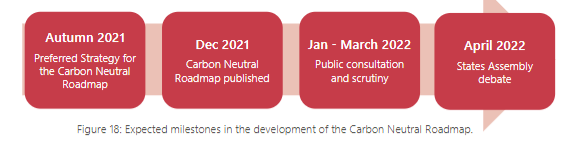
6. Time line for the Carbon Neutral Roadmap – please see below diagram which is taken from the Carbon Neutral Roadmap Preferred Strategy. At the moment the intention is to publish the Carbon Neutral Roadmap in the week beginning 13th December.
Additional questions received by email from PAC officer on 18 November:
Could you confirm you are jointly evaluating the CA on Climate Change and the Citizens' Jury on Assisted Dying and have commenced evidence gathering?
This is correct.
Could you also confirm when you expect the evaluation process to be complete and whether the results will be published?
The SPPP evaluation report will be completed by the end of 2021 and is not due to be published.