
Letter - Minister for Children and Education to CEHA Scrutiny Panel re unregistered children's homes - 2nd June 2023
This content has been automatically generated from the original PDF and some formatting may have been lost, therefore it should not be relied upon to extract citations or propose amendments. Please see the PDF for the official version of the document.
19-21 Broad Street | St Helier Jersey | JE2 3RR
Deputy Catherine Curtis
Chair, Children, Education and Home Affairs Scrutiny Panel
BY EMAIL 2nd June 2023
Dear Chair,
Thank you for your letter of 25th May regarding the recent inspection reports published by the Jersey Care Commission. Please see below the answers to your questions and do not hesitate to contact me if you require any further information.
There have been issues around notification for these types of emergency arrangements. I regret this and have committed to making sure that the reasons for this are clearly investigated, understood, and that this doesn't happen again.
- Please could you provide the Panel with a copy of the relevant CYPES policy (or policies) used by Children's Social Care for the placement of a child whilst under the care of the Government. If any relevant policy has changed in the last 12 months, please provide each version of the policy to the Panel with confirmation of the dates that it was in use.
When the plan for a child to be received into care is agreed or deemed necessary in an emergency situation, action is taken primarily with regard to one of three legal processes.
Article 17: The child may come into care voluntarily with the agreement of their care giver who has parental responsibility under Article 17. This involves the person with parental responsibility (PR) signing an agreement for their child to come into the care of the Minister. The decision to receive a child into care in this way would be taken with the oversight of a Team Manager and Head of Service. The Article 17 consent to care for the child would be signed following discussions between the children's social care service social worker and the person with PR. The Consent Form to receive a child into care under Article 17 of The Children (Jersey) Law 2002 (the Children Law) is included with this letter as an example.
Police Powers of Protection: Receiving a child into care under Police Powers of Protection could occur for a period of 72 hours in order to bring the child out of a situation of risk of significant harm and to move them to a place of safety. This can include another family member's home. Where a child is received into care to a family member or close friend, the viability of this care arrangement is assessed using the guidance flow chart provided with this letter.
Emergency Protection Order: Under The Children (Jersey) Law 2002 (the Children Law), The Children's Social Care Service can apply to the Royal Court to seek an Emergency Protection Order for a child in the event they are assessed as at risk of immediate and ongoing significant harm if they remain in the presenting situation.
The department follows the legal pathway process to plan for bringing children into care where possible. When very urgent situations occur ie: Police use their powers to protect children, these receptions of children into care are generally emergency situations and the service relies on the emergency foster care rota to receive children into a place of safety.
These care situations are temporary and last perhaps a few days to a week to provide time for interim plans to be made for the care of the children and legal advice to be sought.
In addition to consideration of the legal routes to receive children into care, where children are placed in residential care, each care home must adhere to the Jersey Care Commission's Care Standards for Residential Care Homes for Children. These standards set out what must be upheld for children in residential care.
If the care arrangements that were created for the children in this particular example, needed to be set up again in the future for other children, the department would look to try as far as possible to adhere to the conditions set out in Standards 6-14 of the Jersey Care Commission's Residential Children's Homes Standards to create a suitable setting at short notice. It is unlikely that all 16 Standards for Residential Children's Homes would be met at the beginning of such a care arrangement's creation in an emergency situation. The accommodation that was used to stand up care arrangements in this example was private sector accommodation immediately available for booking on the day.
The development of procedures and guidance documents to support practitioners to undertake their duties and responsibilities is a significant area of work underway in the service and will remain an ongoing area of work for some time. However, the MOSAIC recording system is built so that it guides workers and managers to think about what they must consider at the start of a placement for children coming into care. Examples of a blank Placement Plan form and Admissions Checklist form are provided for you to see.
A list of policies is contained within the answer to written question 102/2023.
- Please could you provide details about any work undertaken by Children's Social Care to prepare for the changes to the Regulation of Care (Jersey) Law 2014 (the Law') on 1st January 2023?
In advance of the changes in the Regulation of Care (Jersey) Law 2014 the department officers in the service met with the Chief Inspector of the care Commission and the Commission's external consultants regarding the development of care standards for the new areas of inspection. Those meetings considered areas such as the nature of standards – process or outcome focused, practice in other jurisdictions, the service's own practice standards and the requirements for registration of certain services.
The service was involved in the formal consultation of the proposed care standards and indeed commissioned an assessment and opinion of the proposed standards by an external, independent third party with significant experience in children's social care and in scrutiny and inspection. Officers requested early sight of the Care Commission's development of its Inspection handbook' which is a document used by regulators and scrutiny bodies to outline the framework for inspection. That handbook has not been available.
The service also hosted sessions with the Care Commission and its managers at an information session to prepare for the application to register services. Internally work has been taking place to; identify services which are in the Care Commission's remit for registration, identify the registered managers, and develop the application for registration in advance of the deadline of 30 June 2023.
The Chief Inspector has also presented at the CYPES Department Senior Leadership Team and the Minister at meetings in May 2023. The Minister subsequently attended a Jersey Care Commission Board meeting where this was one of the topics of discussion.
- With specific reference to the three unregistered children's homes identified in the recent reports published by the JCC please could you provide some background information about how the breaches of the Law occurred, to include:
- Confirmation of why the children's homes were used when they were not registered with the JCC.
There are will always be cases where staff have to make difficult and prompt decisions when a child is at risk of harm. This sometimes includes providing emergency temporary accommodation with appropriately qualified and experienced social workers and family support officers. In all cases, this is done in accordance with the decision of the courts. Temporary accommodation is only used as a last resort when we have been unable to find a suitable placement in a registered home or with other carers.
I refer to a letter sent to the Jersey Care Commission on the 12th January 2023 which clearly sets out the circumstances at the time and the details around how the breaches of the law occurred. This letter is provided on a confidential basis to the Panel only because the detail therein has the potential to identify the children in question. I hope this letter explains in full what was happening at the time and the plan for each of the three children in question.
- Details about the process to approve the placement of children, including confirmation of where the decision was made and how it corresponds to the organizational structure within Children's Social Care.
The process to approve the creation of emergency care arrangements for Children in the Care of the Minister is followed through the line management levels of responsibility up to Director level in the operational management structure. The Social Worker and Team Manager identify and assess the need for an emergency care arrangement to be set up. This would be brought to the Head of Service for discussion and scrutiny to ensure all alternative arrangements have been carefully considered before requesting agreement for the emergency care setting ie: temporarily increasing capacity of existing foster carers to accommodate additional children, looking at family and friends wider than the immediate family group, bolstering the current care arrangements with additional support (if it is both safe and possible to do so). If satisfied that all possible alternative options have been considered, then the Head of Service seeks agreement from the Associate Director and Group Director for Children's Social Care Services to create emergency care arrangements. Emergency Care arrangements would only be considered in the absence of any other suitable option including leaving the child in situ.
- Confirmation of how long each of the unregistered homes was in use for.
In my letter to the Care Commission dated 12th January 2023, the start dates for the children's care arrangements are included. Two siblings started their care arrangements under Emergency Protection Orders on the 7th December and one child on the 9th December. You will appreciate that the plan for the single child, prior to starting their care arrangement on the 9th December, was to move the child to an identified specialist residential setting in the UK ready to receive the child into their care.
However, the Court process to agree to the move of this child off island needed to take its course and this prevented us from reaching stability for this child sooner, without having to set up a temporary care arrangement.
The care arrangements ended across the three settings as follows: Home 1 – 08/12/22 – 08/02/23
Home 2 – 09/12/23 – 30/01/23
Home 3 – 31/01/23 – 03/03/23
Homes 2 and 3 were for the same child.
- Other than the three unregistered children's homes reported on by the Jersey Care Commission, please could you confirm whether there are any other instances where children have been placed in an unregistered children's home (since 1st January 2023), or unregistered care home (before 31st December 2022, as defined by the Law).
There have been additional instances where children have been placed in an unregistered children's home as follows:
26/03/21 – 05/06/21 – unregistered children's home (Acorn)
Context for opening the home was following breakdown of foster placement, giving temporary space for the child and foster parent to work with professionals towards a reunification to the foster carer. There was a move to Le Croix Cottage 27/04/21 temporarily within this time. The JCC were fully informed of all plans ahead of the move, however chose not to be involved further and did not inspect this activity.
07/06/21 – 02/08/21 - unregistered children's home. (Les Ormes)
Context for opening the home was that there were no available registered placements. The young person self-referred into care. There was hope that re-unification with parent would be successful. This was not successful. The JCC were aware of this activity and the previous Chief Inspector advised;
In order to comply with your statutory obligations under the Law, I would be obliged if you would confirm either your intention to:
- cease the unregistered and unregulated activity referred to above and advise me of the date the service will cease to operate; or
- submit an application to register Les Ormes as a care home service, even on a temporary basis. There is a past precedent for doing so but I must point out that the Commission will not grant registration unless and until the necessary conditions set out in the relevant Regulations and Standards have been met.
The Jersey Care Commission did not inspect this activity.
03/03/23 – unregistered children's home (Westmount) undergoing registration.
The context for opening the home at Westmount was to be able to close unregulated care as referred to as homes 1, 2, 3. Westmount was in the process of registration as a permanent home. This allowed for the transition of other young people into Westmount to make availability in other homes for 4 new children. The Jersey Care Commission was fully involved in the process of moving children prior to registering this home. The home was registered on the 16th of May 2023, and we are awaiting confirmation of registration by the Jersey Care Commission.
22/05/23 – unregistered home (Seaview) undergoing registration.
The Context for opening Seaview was to provide a long-term home for a young person who was in secure provision. The Secure Accommodation Order for the child was not extended and the plan for the young person to leave the Secure Children's Home was expedited. The service is working closely with the Jersey Care Commission to secure registration.
Notification was made to the Care Commission who were aware that children were placed in these homes prior to registration being granted, and agreed this was the most appropriate option for the children concerned.
- In the last 12 months how many instances have children or young people been put into emergency care? Please break down to answer to include placements into children's homes, foster care, off-Island care, etc.
In the last 12 months, children have been received into care, or have had to move in an emergency on 21 occasions as detailed below:
Children's Homes x 6 emergency admissions 27/06/22 – registered children's home (Hautlieu) 01/07/22 – registered children's home (Hautlieu) 13/09/22 – registered children's home (Vue de l'Ecole) 08/12/22 – registered children's home (Casa Mia) 01/02/23 – registered children's home (Casa Mia) 15/02/23 – registered children's home. (Casa Mia)
Foster care x 14 emergency admissions 18/08/22 – foster carers x 3
24/08/22 – parent and child foster carers x 2 25/08/22 - foster carers
31/08/22 – foster carers
30/09/22 – foster carers
12/10/22 – foster carers
23/02/23 – foster carers
29/11/22 – connected carers x 2
27/01/23 – connected carers x 2
Off Island:
03/08/2022- connected carers received a young person into their care after the closure of the child's residential home by OFSTED.
- Please provide confirmation of the following:
- How many children in care are currently being looked after outside of the Island? 17
- What percentage of children in care are currently being looked after outside of the Island?
24.6%
- The total number of children that have been placed in care outside of the Island since January 2022.
2
- Is there a formal process for children and young people in the care of the Government to provide feedback or formally record concerns about their living environment?
Yes, please see below for detail.
a. What independent support is available to children or young people in children's homes and how are children and young people informed about this?
There are several forms of support as detailed below: Independent Reviewing Officer
The process to set up independent support for children in the care of the Minister is as follows. When a child is received into care, a notification is sent to the Independent Reviewing Officer Service based within the Standards and Quality Service. An Independent Reviewing Officer (IRO) is assigned to oversee and scrutinise the care plan for the child. The Independent Reviewing Officer will book a Child in care Review meeting to take place within the first 28 days of the child being in care.
Advocacy
Children should be spoken to by their social worker and their carers about their rights to access advocacy and how to make a complaint if they are not happy. This should be undertaken within the first 5 days of the placement being made. Within 5 days, there should be a placement planning meeting where the contents of the placement plan document are discussed and agreed. An example of a blank placement plan has been provided with this letter for your reference. The Admissions Checklist details the action to offer advocacy as its first point.
Feedback Portal
The Children's Social Care Service has a designated officer responsible for feedback who receives and assigns all complaints made into the department.
Children are advised how to use the Government of Jersey's Feedback portal to advise us of anything they are not happy with or worried about.
Children who are living in Residential Care receive a Children's Guide. A step-by-step process on how to make a complaint is detailed in the children's guide in each home. A copy of the complaints form is included in the children's guide and support will be provided to complete this if needed. The addresses of who the child can complain to is also included. This includes the details of the children's social work service, the NSPCC, Children's Commissioner, and the feedback' service.
Mind of My Own
The Children's Social Care Service uses the Mind of My Own app based method as a communication tool to enable children to be able to send information into the service for action. All children are shown the app and encouraged to use it to communicate with the service. Any statements that are sent into the department are picked up in the Standards and Quality Service and actioned. A recent example I can provide in terms of the effective use of the app was when a child living in care in the UK sent a statement to tell us how useful his therapy was for him and how he would like this to continue. This has helped the service to understand how best to support this young person and the Independent Placements Panel have recently agreed funding to continue with the therapeutic support for this young person for a period of time.
Independent Visitor (Reg 31)
Children living in Residential Care receive a monthly visit from an Independent Visitor in accordance with Regulation 31 of the Regulation of Care (Standards and Requirements) (Jersey) Regulations 2018. The Independent Visitors speak to the residents of the children's homes to look at how the providers are meeting the needs of the children in their care.
Children's Guardian
Children who are subject of Court proceedings have a Guardian ad Litem assigned to represent the voice of the child in the Court process. The children have access to their Guardians to talk to them about any worries they may have, or anything they are not happy about, which will be raised and addressed with the Social Care Service in communication with the Jersey Family Court Advisory Service (JFCAS).
Access to lawyer
In court proceedings children have their own lawyer appointed by the Court from a panel of specialist lawyers. Lawyers will spend time alone with the children and represent their views in proceedings.
- Is there a formal whistleblowing policy in place for staff within Children's Social Care?
Yes. There is a Government of Jersey Whistle Blowing Policy which applies to all Jersey public servants on permanent contracts and non-permanent contracts of employment or
agreements, including those on zero-hour contracts and those providing services to the public sector under a contract.
- The Panel recalls the funding approved in the Government Plan for the Children's Social Care Reform programme, but notes that some of the issues highlighted in the JCC reports include: long working hours for staff, high turnover of staff, lack of safe recruitment practices, lack of mandatory training and supervision for staff, and lack of management oversight. Please could you advise the progress of the Children's Social Care Reform programme to address these issues at this juncture in 2023.
Funding for the social care reform Programme commenced in January 2023 with work across the five areas including the priority of Providing Loving Homes (for children in the care of the Minister).
The residential service has had significant levels of staff vacancy across the homes with active attempts to address this issue including a new recruitment campaign, the removal of the five-year residency requirement, the issuing of licences to recruit senior staff off island and employing agency staff to cover vacancies.
At the time of setting up the emergency arrangements for the very small number of children concerned there were no alternative places available and no safe option to leave the children in situ. They required to be in care. This meant getting staff in place to care for the children and asking staff employed by the service to do additional hours to support the children. These staff were qualified and registered social workers and family support workers – all of whom had gone through the necessary safe recruitment processes. There were more staff involved in the care of the children than the optimum however the staffing ratios and needs of the children, vacancy situation and cover for leave (particularly over the festive period) exacerbated this issue. Staff were prepared to work additional hours to make sure the children were cared for and supported.
There was no registered manager in place as these were not registered homes however there was regular management oversight with team managers and a head of service reviewing the situation on a daily basis. This was an issue that was a priority for resolution for all concerned.
In the third arrangement there was a residential registered manager who had responsibility of overseeing standard operating arrangements.
As part of the reform programme, it is proposed to explore working with an external highly regarded organisation to assist in the improvement and transformation of residential services this will include developing the practice model. Work is underway on the staff model for homes to ensure that it is fit for purpose for the future and meets the changing needs of the child in care population. We have recruited additional posts for quality assurance and for training and development for the residential service.
Work is in progress to implement the therapeutic children's home and it is hoped that this will be operational in 2024.
As stated above two new homes have been opened creating homes for up to four children with another property identified for young people aged 15-18 years, refurbishment work will take place this year and it is hoped this home will be operational in 2024.
There are eight live' fostering assessments underway and are scheduled to be presented to the Panel and Agency Decision Maker in June and August 2023.
- Have you been made aware whether any formal proceedings will be taken against Children's Social Care in relation to the breaches of the Regulation of Care (Jersey) Law 2014?
I have been advised that there will be no formal proceedings. Yours sincerely,
Deputy Inna Gardiner
Minister for Children and Education D +44 (0)1534 440152

 VOLUNTARY AGREEMENT UNDER ARTICLE 17 JERSEY CHILDREN LAW 2002
- THE RELEVANT PERSONS
The child's name:
The persons with parental responsibility: Date:
- THE AGREEMENT
This is an agreement between the Minister for Education and Children and [persons with parental responsibility].
The agreement is that [child's name] will be placed in [ foster care/ residential care]
In legal terms, that placement is happening under Article 17 of the Children (Jersey) Law 2002.
- The placement and the children's wishes
The purpose of that placement is (explain clearly).
The current plan is that [current plan for child's return home] and that the [child] will remain accommodated by The Minister for Education and Children for a period of [x days, weeks, months].
It [has / has not] been possible to find out the [child's name] wishes and feelings. [The child's] wishes and feelings are [wishes and feelings].
- Agreement of the persons with parental responsibility and right to remove
[The persons with parental responsibility] do not at the moment object to [the children] being placed in [say, foster care].
[The persons with parental responsibility] may at any time remove [the child's name] from the placement. [The persons with parental responsibility] [has / has not] had legal advice and has the right to continue to seek independent legal advice.
[This is / this is not] an agreement for the accommodation of a new-born baby or child under six months.
If it is an agreement for the accommodation of a newborn baby or child under six months, and the exceptional circumstances requiring the use of this provision are [exceptional circumstances].
- Reviews
The Minister intends for the social worker to review this placement every [X weeks] and the persons with parental responsibility will, after each review, be updated by the Children's Social Care on its plan moving forward.
Additional reviews may be requested in response to any changes.
- SIGNATURES
Signature: Signed and dated:
• [The persons with parental responsibility]
• [The social worker]
Where required to be translated into a foreign language:
• This document has been written in English and translated into [ language].
• The [persons with parental responsibility] have read it in [ language].
- Signed and dated in [language]: ["I have read this document and agree to its terms"].
- Signed and dated by [named interpreter].
Where an advocate or intermediary has assisted
The [person with parental responsibility] has been assisted by [name; advocate / intermediary].
I [advocate / intermediary] confirm that I have read this document with and explained it to [person with parental responsibility] and I am satisfied that the [person with parental responsibility] understands its contents.
[Signed and dated by advocate / intermediary].
Check list for Children's Social Care
• Have you taken every person with parental responsibility carefully through this agreement and ensured they fully understand the consequences of giving such consent?
• Have you ensured that the persons with parental responsibility have all the facts and issues relevant to the giving of consent.
• If the persons with parental responsibility are not native English speakers, has the agreement been translated into their native language?
• Even where a person with parental responsibility is giving consent, the social worker must have regards to the following:
o Parent's current physical and psychological state of mind.
o Encourage parents to seek legal advice or at least advice from friends or family.
o Ensured all options have been explored, and removing the child is the only viable option to ensure safety for the child.
o Ensured that they have been informed why a Court Order is not favoured in the case? Rather Article 17 accommodation is preferred even though there are safeguarding concerns.
• Are you satisfied that the persons with parental responsibility have capacity to consent?
• Are you satisfied that the persons with parental responsibility have consented?
• Have the relevant persons with parental responsibility signed a consent form for medical treatment/examination or disclosure of the child's medical records.
• Ensure a copy of this document is handed to those persons who have parental responsibility.
Last Updated: 8.07.2021.
 Viability Assessment Step by Step Process Child is unable to live at home
The family, child or young person puts someone forward as A family member, friend or a connected person puts themselves a potential carer for the child. forward to care for the child.
The child's social worker to make contact with the Child's social worker to discuss this with the parent/carer (who people/person being put forward to gain their views and holds PR) and seek their views and agreement with assessing agreement. Do the connected persons want to proceed? the person/family. Do the parents/carer agree with the process
proceeding?
No – record outcome on Mosaic
Yes and take no further action Yes No
If the parent/carer does not give agree with the
person/couple being assessed, but this is deemed
to be in the child's best interests, management
oversight and legal advice would need to be Child's social worker to begin Initial Checks as follows: sought. Is decision made to override?
• Gain consent from the Connected Persons to create new files on Mosaic and to
complete the checks required as per below.
• Run a check of Children's Services Records – are the connected carers known? What Yes No is the relevant history and involvement?
• Run a Local Police check.
Do the initial checks raise any concerns?
Yes No
• Feedback outcome to parent/carer and connected persons
• Record outcome on Childs File
• Take no further action
Childs social worker can now make a referral to the Fostering and Adoption Team for a Viability Assessment to be undertaken
 The Childs social worker can rule a person/couple out on the basis
of checks undertaken, where they are deemed to be unsafe or
Fostering & Adoption Team will allocate a unable to provide a suitable standard of care for the child.
Supervising Social Worker
• Examples of this would be where a person/couple already
has children removed, on the CP Register or where they
have a history of violent offences, drug or alcohol Joint Viability Assessment Begins dependency or significant mental health difficulties.
7 Working Day Timeframe starts.
• A rule out' would need to be agreed with management
oversight and a case note recorded on the child's file to
clarify this decision (not the details). Supervising Social Worker will make contact with
Connected Person and confirm process and detail
• The person/couple put forward, would need to be of Viability Assessment to be completed jointly informed of this decision and why. The family/child can with CSW
also be told of the decision but not any details due to
confidentiality/data protection issues.
Supervising Social Worker and Childs Social worker will jointly complete
• The person/couple need to be informed of the Viability assessment.
decision and given a copy of the assessment. Supervising Social Worker completes Sections C and E
• The child/family also need to be informed and Yes Childs Social Worker completes Section A and B
prepared for the assessment and arrival of the child. to Front Sheet & Recommendation are completed jointly
both On balance of all information gatheredyou the need to decide;
• The family needs to be supported to have everything 1 & 2 1) Is the person/couple viable for a full connected person
they need before the child moves in. assessment or not?
• The child cannot move in until the assessment has 2) If so, can the child be placed there safely whilst an
ben signed off. assessment is carried out?
• Team Manager needs to sign the assessment off.
Child moves in with Connected Carer/s
No to both 1 & 2 Yes to 1 and No to 2
The person/couple become temporarily approved from the day the viability assessment is completed/signed off.
They need to complete an application form as connected person carers.
The full connected person assessment is taken to Fostering Panel within 12 weeks of assessment being completed, for formal approval.
During this time they are supervised and supported by the fostering team whilst a full connected person assessment is completed, this includes financial support.
The person/couple needs to be informed, given a copy Tthhee ass persesosnm/ceonut. Tpleh ney maeedsy n to beeed i nsufoprmeportd w, githive tnh a cis aosp thy oisf of the assessment. They need to be prepared for the
might be a very difficult for them, especially if a close assessment process and given an explanation as to relative. why the child is not being placed whilst the
assessment is underway.
When telling the child/family the outcome– always
remember issues of confidentiality and data protection. They need to complete an application form as Record a case note on the child's file to explain the connected person carers.
negative viability, but not the reasons why as these are The full connected person assessment is taken to confidential to that person/couple. Need to track Fostering Panel within 12 week, for formal approval. decisions and actions only.
(Placement Date and Legal Status)

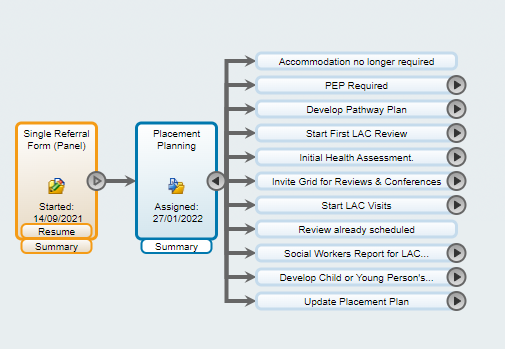 The process starts with a panel request
 Select it from the start menu

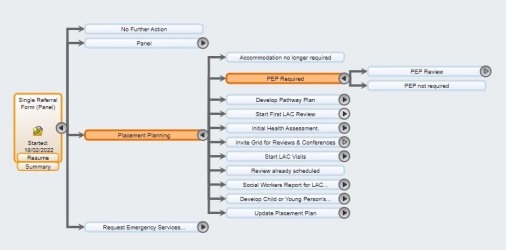 You can start different workflows from this step e.g a PEP
(Placement Date and Legal Status)

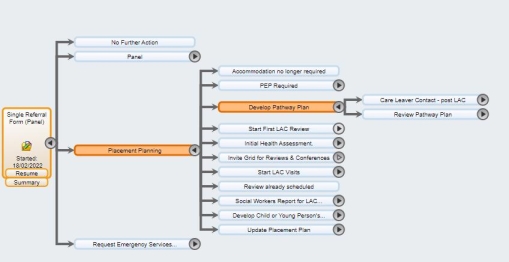 A Pathway Plan

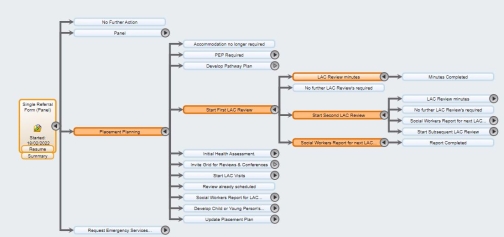 First LAC Review

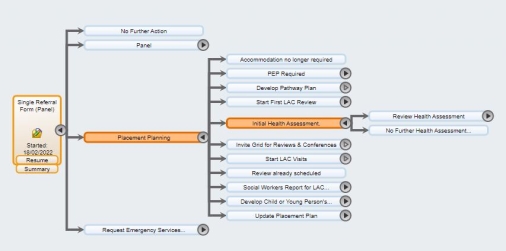 Health Assessment
(Placement Date and Legal Status)

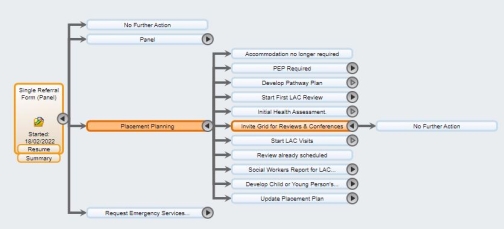 Invite Grid

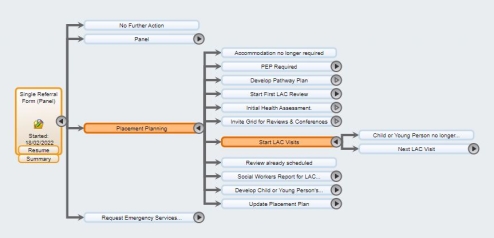 CLA Visits

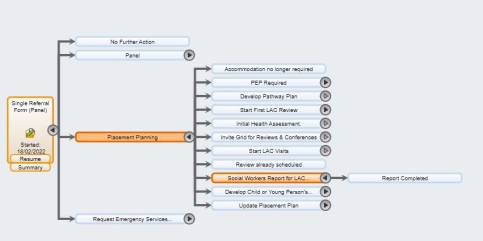 SW report for LAC review
(Placement Date and Legal Status)

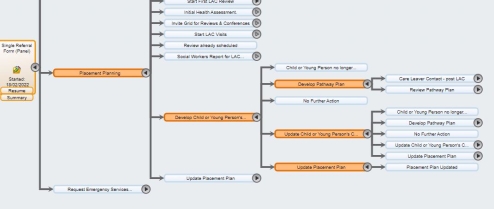 Develop Care Plan

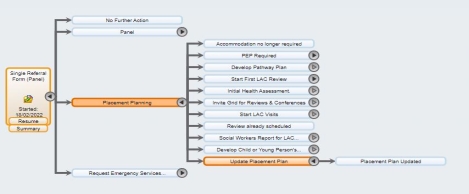 Update the placement plan
 Placement Plan
 Child / young person's details
Name Date of birth Sex



 Disabled Ethnicity Religion


Communication needs (including language)

Current legal status
 Current placement
type
Any further information regarding legal status / immigration status
 Request for placement details
Name of person making request
 Reason Placement is required
 Preferred choice of Placement type
 If other, specify
Placement considerations
 Date placement required
 Has edge of care been considered
Yes No
 What attempts have been made to arrange for the child / young person to live with
a relative or a close family friend as an alternative to care or accommodation if the child / young person is not already in a family or friends placement?
 Approve placement request
 Team manager agreed to proceed with the placement
 Yes No Head of service agreed to proceed with the placement
Yes No
 Details of involved professionals
Professional(s)
Designation | Name | Agency | Telephone | Send Notification | |
|
|
|
|
|
|
What support services are available to carer(s) outside of office hours, who can be contacted and how?

 Jersey Cares Support
Accepted Rejected
 Comments
All about the child / young person
Give a 'pen picture' of the child / young person

What immediate information does the carer require to be able to look after the child / young person (consider the child's routine, likes, dislikes, favourite toy etc)?

Summary of child's background and placement history
 Details of the child's identity, religious persuasion, cultural and linguistic background, and racial origin

Details of the child's social / leisure activities that need to continue within the placement

 Is the young person a parent?
Yes No
 Child / young person's needs
Emotional and behavioural issues

Management strategies (including roles and responsibilities and support in place / required, mitigation of any impact on other children in the placement). Detail which action will be carried out by whom and by when

Details of the child / young person's self-care skills programme

Health
 Summary of child / young person's health
 Education Name and address
 Does the child / young person have an education need
Yes No
 Summary of child / young person's education
 Placement details and panel decisions
 Reason for placement change
First placement Planned change Unplanned change
 Is this an emergency placement
Yes No
Date of placement If a series of short breaks, the period covered by this placement


Carer(s) details
Name | Telephone | Address |
|
|
|
Give details of any agreed backup / respite care arrangements

Reason for choosing this placement

Is additional resource / support required to meet the child's need in this placement?

 Panel decisions
 Have panel decisions been uploaded to Mosaic
Yes No
 Panel decision
Agreed to accommodate Did not agree to Other
accommodate
 Record panel decision Panel chaired by:
Date panel took place
Please note: You are not required to complete any further sections of this form until,
Panel and Head of Service have agreed to the placement
Placement duration and plan dates
Expected duration of the placement

Contingency plan for any disruption or breakdown of placement

Plan dates
 Date of this placement plan
 Has a delegated responsibility form been completed with the parent / carer?
yes No Not appropriate
 If yes, date completed
 If no, when will this be completed
 If the young person has been detained, will this be used as a detention placement plan?
Yes No
 Contact arrangements
Detail any Court Orders relating to contact

Contact for child / young person
Person | Frequency | Type | Arrangements |
|
|
|
|
What are the arrangements for notifying any changes in contact arrangements

People with whom the contact is restricted / forbidden
Name | Relationship | Reasons | Authority |
|
|
|
|
 Health
Current medication
Name of medication | Dosage | Frequency | How administered |
|
|
|
|
 GP Details Name
Telephone
Address
Details of outstanding medical or dental appointments

Who is responsible for ensuring attendance at appointments?

Known allergies and / or medical conditions

Special equipment required, who will provide and how the carer will be trained to use it

Specific dietary needs or restrictions for health, religious or other reasons

For arrangements regarding delegation and exercise of responsibility for consent to medical examination and dental examination or treatment, see Consent to Medical Treatment and Placement form
Any changes to these arrangements MUST be recorded on a new Consent to Medical Treatment and Placement form
 Education
 School
Name Address Telephone



LAC designated teacher Date started


Education History

Awards / achievements

If the child / young person is not to continue to attend the current school please give reason and new arrangements

 Does the child / young person need to change school due to foster placement change?
Yes No
Has the school been informed that the child / young person has become Looked After or changed placement? If not, who will do this and when?

If the child / young person has a Record of Need for Education give details of the arrangements, contact person and responsible authority

Contact with school / establishment

How will the child / young person get to and from school?

Are there any issues concerning contact that the school should be aware of?

Are there any issues concerning attendance that the school should be aware of?
 Visits
Arrangements made for the child / young person to visit prior to the placement commencing

Arrangements made for the child to be visited during the placement

Arrangements made for advice, support and assistance to be available to the child between visits
 Arrangements made
for support to carers
Arrangements made for the independent agency to visit the child (If appropriate)
 Financial support
Arrangements for the financial support of the child / young person during the placement

Provision / equipment required

Additional information for placements with parents
Details of support and services to be provided to the parents during the placement

 Parents have agreed to inform the authority of any relevant change in circumstances
Yes No
 Parents have agreed to ensure that any information relating to the placement remains confidential and not disclose information to any other parties
Yes No
Circumstances in which the placement agreement and / or placement will be changed and / or ended

Circumstances in which it is necessary to obtain in advance the approval of the responsible authority for the child to live even temporarily in a household other than the parent's household

Additional information for placements made under Article 17
What aspects of day to day care have not been delegated to the carer?
 Additional information - recording and sharing
Details of any specific information the carer is required to keep a record of

What are the known safeguarding concerns and arrangements specific to this placement

Outline communication arrangement between the carer and the Service

Outline the carer's responsibilities for notifying the child's social worker and the Service of any significant changes in the child's circumstances

 Copy of placement plan provided to:
 Foster carer / residential worker
Plan provided
 Parent
Plan provided
 The above information is correct to the best of my knowledge and belief Name Signature Date
 Signatures

 Residential worker I agree to look after
at
 (placement address)
Name Signature Date



 Approved Foster Carers
 I / we agree to look after at the placement address and to comply with all aspects of the foster care agreement as stated in the Fostering Services Regulations. I / we have received written information concerning these regulations. I / we also agree to co-operate with all arrangements made by (the Service / other agency)
 Foster carer 1
 Name Signature Date Foster carer 2
Name Signature Date
 Relative / Friend
I / we agree to look after at the placement address for a period not exceeding sixteen weeks and to comply with all aspects of the foster care agreement. I / we have received written information concerning this.
I / we also agree to co-operate with all arrangements made by (the Service / other agency) 
 for him / her
 Relative / friend 1
Name Signature Date
 Relative / friend 2
Name Signature Date
 Child / young person
(If of sufficient age and understanding and if the young person concerned is 16 or over and being accommodated without parental consent s/he should be encouraged to sign this agreement).
I agree to be looked after by
 (the Service / other agency)
 at
at
Name Signature Date



 Residential Admissions Checklist

 Advocacy Advocacy
 Has the role and offer of Independent Advocacy been discussed with the Child/YP?
Yes No N/A (child under 5)
 Date
Date
 Which service was offered to the Child/YP?
Barnardo's Jersey Cares N/A
 Has the Child/YP had the opportunity to meet with the Independent Advocacy Service?
Yes No N/A (child under 5)
 Date
Date
 Was the Independent Advocacy Service taken up by the Child/YP?
Yes No N/A (child under 5)
 Date
Date
If no, why?
Admissions Checklist
 Child / young person details
Name Date of birth


Address

 Checklist
 LAC 1 Admission, Medical, Activity consent form to arrive on admission
Yes No
Action

 LAC 2 essential information' sheet to be obtained from Social Worker and relevant info filled onto YP's General Info and contact sheet
Yes No Action

 LAC nurse informed & medical process commenced
Yes No
Action

 Any current medication to be entered on to blank MARS sheet until Boots have been informed and doctors non-prescribed medication paperwork is signed
Yes No Action

 Set up Missing Persons form with current photo.
Yes No
Action

 Inform y/p of fire evacuation procedure from room and communal areas of the building
Yes No Action

 Young person welcomed, welcome pack provided. Discussion regarding allocation of keyworker
Yes No Action

 Young person's birthday written in diary + any relevant appointments
Yes No
Action

 School informed of YP's residence and acquire teacher's name as point of contact
Yes No
Action

 Welcome sheet shared with YP. YP to be allocated a designated keyworker as soon as possible and this information shared with YP
Yes No Action

 All relevant info to be entered onto office board
Yes No
Action

 LAC 4 Planning Meeting to be set up by Social Worker within 5 calendar days
Yes No
Action

 Individual file set up in office
Yes No
Action

 LAC 3 notification of change on discharge to be received by Social Worker before file is archived
Yes No
Action
